Most teams do not struggle because they lack social channels. They struggle because every channel creates another queue, another approval step, another media format, and another place where something can fail. Once Pinterest, LinkedIn, Instagram, and Facebook are all active, the real problem becomes operations.
The fastest way to reduce that friction is to treat social publishing like a system instead of a set of isolated tasks. AI helps, but only when it sits inside a workflow that already has clear inputs, target accounts, publishing rules, and review points.
Why multi-platform social usually breaks down
Most teams add channels one by one. Pinterest is handled in one tool, LinkedIn drafts live in a document, Instagram assets are scattered across a folder, and Facebook posts are rebuilt manually at the last minute. That setup can work for a short period, but it usually creates the same four problems:
- Content gets rewritten repeatedly for each network.
- Media files are uploaded multiple times in different places.
- Scheduling decisions are made too late.
- Failed publishes are noticed only after the posting window is gone.
Multi-platform scheduling becomes manageable once the workflow is centralized and each network becomes an output, not a separate process.
Start with one content source, not four
The cleanest model is to begin with one campaign brief or one product theme and branch the channel variants from there. For example, if you are promoting a sewing pattern bundle, you do not need four separate ideation sessions. You need one campaign source that contains:
- the offer
- the audience angle
- the core visual assets
- the destination link
- the publishing window
From that base, AI can generate network-specific copy faster and more consistently than a manual rewrite process.
Assign each platform a role
Teams create unnecessary complexity when every network is asked to do the same job. A better system is to define the role of each platform first.
- Pinterest: evergreen discovery, saved intent, product traffic.
- LinkedIn: authority, announcements, founder or brand credibility.
- Instagram: visual engagement, short-form product storytelling, reels.
- Facebook: community visibility, reshared promotions, direct reach for existing followers.
Once those roles are clear, your AI prompts improve immediately because each output has a defined goal.
The four-stage AI workflow
A practical setup for a small team or solo operator is:
- Plan: define the campaign, offer, dates, and target profiles.
- Draft: use AI to generate platform-specific copy variations.
- Schedule: attach media, choose boards or targets, and queue the content.
- Publish and monitor: check statuses, fix failures, and review what performed best.
What matters is not whether AI writes every final word. What matters is that it removes repetitive setup work so the team can spend more time on judgment and quality control.
What a good weekly system looks like
Most teams do not need a complicated content operation. A simple weekly rhythm is enough:
- Monday: choose products, campaigns, or topics for the week.
- Tuesday: generate copy angles and prepare media assets.
- Wednesday: schedule Pinterest pins and long-tail content first.
- Thursday: queue LinkedIn, Instagram, and Facebook variants.
- Friday: review publishes, failures, and top-performing posts.
This works because it separates planning from scheduling. Without that separation, teams spend too much time deciding what to post at the same time they are trying to publish it.
Where AI creates the most leverage
AI is strongest when used for structured repetition, not for replacing strategy. In a social workflow, the highest leverage tasks are:
- turning one product angle into multiple post variants
- adjusting tone by network
- rewriting hooks and CTAs
- preparing captions, descriptions, and post drafts in batches
- orchestrating scheduling tasks through MCP or API calls
The more consistent your content inputs are, the better those outputs become.
Why MCP changes the process
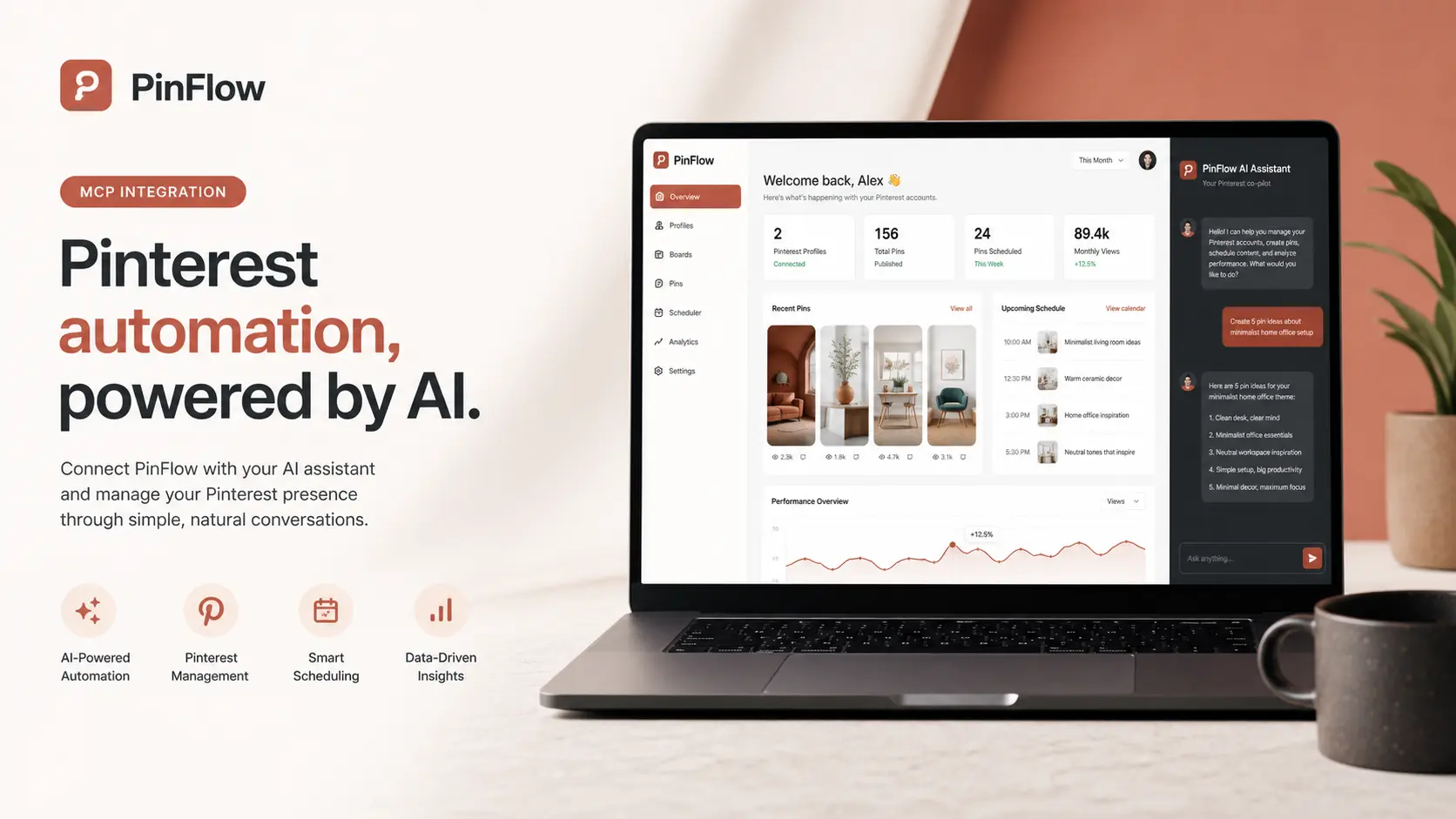
Without MCP, AI can suggest copy but cannot complete the workflow. With MCP, the agent can inspect connected profiles, list boards or targets, create drafts, and publish or schedule content directly in PinFlow. That reduces the gap between planning and execution.
This is especially useful for teams that want to move from “AI helps me brainstorm” to “AI helps me operate the system.”
Operational rules that keep the workflow clean
If you want the setup to stay reliable as volume grows, keep these rules in place:
- Upload media once and reuse the hosted URL across workflows when possible.
- Keep naming and slug patterns consistent for campaigns.
- Use draft status first when testing a new network or target.
- Check failure reasons every day instead of assuming queued means safe.
- Review monthly usage and storage before it becomes a billing surprise.
These rules are simple, but they prevent most of the friction that makes multi-platform posting feel chaotic.
What to measure
Do not judge the workflow only by engagement metrics. Also track the operating metrics:
- how many posts were scheduled this week
- how many failed and why
- how long it took from idea to queue
- which channels consume the most manual cleanup
If AI and automation are working correctly, those operational metrics should improve before top-line traffic results are fully visible.
Final takeaway
Running four social networks does not require four separate systems. It requires one clean publishing layer, one repeatable content process, and a clear role for AI inside that process. Once planning, drafting, scheduling, and publishing are all connected, multi-platform social becomes much easier to scale without adding more manual overhead.